Pipeline

We possess multiple pipelines that leverage the properties of 211At, including af-001(TAH-1005) and af-002(PSW-1025), which are currently being evaluated in clinical trials. Furthermore, we are advancing proof-of-concept studies in the discovery phase for both cell membrane surface and intracellular targets, combining 211At with small molecules and peptide ligands.

af-001(TAH-1005)

target:NIS(Symporter)

Small molecule
Phase 1

Thyroid Cancer (RAl-refractory)

af-001

target:NIS(Symporter)

Small molecule
Phase 1

Thyroid Cancer (RAI-naïve)

af-002(PSW-1025)

target:PSMA(Cell membrane)

Small molecule
IND-enabling

Prostate Cancer (Refractory)

af-003

target:LAT1(Transporter)

Small molecule
IND-enabling

Pan-Cancer

Tanabe-Veneno

target:Undisclosed

Peptide (DRP)
Exploratory

Multiple Molecular Targets

In-house Program

target:Undisclosed

Small molecule
Exploratory

Multiple Molecular Targets

af-001 (TAH-1005)
Radioactive iodine (131I) therapy has long been the standard treatment for differentiated thyroid cancer. However, some patients do notachieve sufficient therapeutic effect even after repeated 131I administrations. Astatine-211 ( 211 At), a chemically similar element to iodine, emits potent alpha particles that can deliver highly localized and powerful radiation, offering the potential for greater tumor control. Dr. Tadashi Watabe, MD, PhD, at the Graduate School of Medicine, the University of Osaka, conducted the first-in-human clinical trial of sodium astatide injection ([211At]NaAt) in 11 patients with thyroid cancer resistant to standard therapy (Alpha-T1 trial). The study confirmed that [ 211 At]NaAt can be administered safely. Remarkably, among patients receiving medium to high doses, three showed a ≥50% reduction in tumor markers, and in three cases metastatic lesions disappeared or nearly disappeared on radioactive iodine imaging. Building on this success, Alpha Fusion is preparing to launch a company-sponsored clinical trial of its lead candidate af-001. This next-generation therapy is designed to be more patient-friendly than conventional 131I treatment, eliminating the need for hospitalization in specialized wards and enabling administration in an outpatient setting. This breakthrough paves the way toward a new era of targeted alpha therapy, aiming to deliver safe, effective, and more the patient-centric treatment for advanced thyroid cancer.
Best change in thyroglobulin (%)
甲状腺癌患者における[211At]NaAt投与前後の131I集積画像の経時的変化
  1. Waterfall plots showing the maximum change in serum thyroglobulin levels at 3 or 6 months after administration of [211At]NaAt. (* Measured without rhTSH stimulation.)
  2. Representative 131I planar and SPECT/CT images in a patient with follicular thyroid cancer with multiple bone metastasis at baseline, and at 3 and 6 months after administration of [211At]NaAt (3.5MBq/kg). A gradual decrease in 131I accumulation in the lumbar spine and sacral metastases was observed over time.

Quotation:
Watabe T., Mukai K., Naka S. et al. First-in-Human Study of [211At]NaAt as Targeted α-Therapy in Patients with Radioiodine-Refractory Thyroid Cancer (Alpha-T1 Trial). Journal of Nuclear Medicine September 2025, DOI: https://doi.org/10.2967/jnumed.125.270810

af-002 (PSW-1025)
Prostate cancer affects nearly 300,000 men each year in the United States and is the most common cancer among men in Japan, with about 90,000 new cases annually. Although hormonal therapy is typically used for recurrent disease after surgery or radiation, castration-resistant prostate cancer (CRPC) with multiple metastases remains challenging to treat and carries a poor prognosis. Recent advances in targeted radiotherapy have focused on the prostate-specific membrane antigen (PSMA), a protein highly expressed in prostate cancer cells. Dr. Tadashi Watabe, MD, PhD, at the Graduate School of Medicine, Osaka University, has developed and evaluated [211At]PSMA-5, an innovative PSMA-targeted alpha-emitting radiopharmaceutical. In preclinical prostate cancer models, [211At]PSMA-5 demonstrated remarkable tumor uptake and sustained tumor regression. Building on these promising findings, the team is now conducting a Phase I investigator-initiated clinical trial (Alpha-PS1 trial) at Osaka University Hospital. Early clinical imaging has confirmed tumor accumulation of [211At]PSMA-5, fueling expectations for therapeutic efficacy. To accelerate clinical translation, Alpha Fusion is advancing the development of this novel agent as af-002, aiming to bring a new, highly targeted treatment option to patients with advanced prostate cancer.
Best change in thyroglobulin (%)
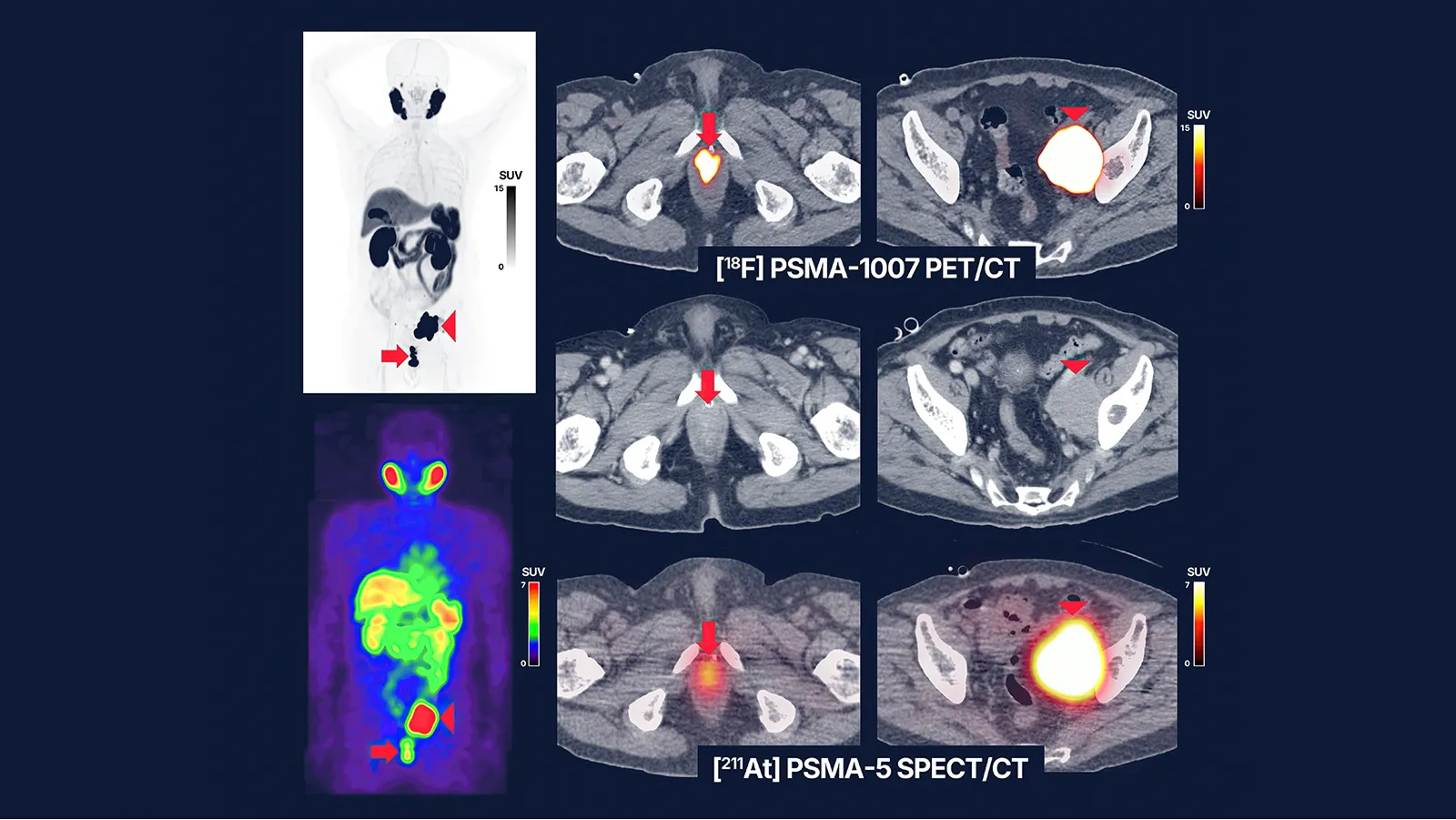
  • Pre-treatment [18F]PSMA-1007 PET/CT (A) and [211At]PSMA-5 SPECT/CT (B) images showed similar distribution patterns, with high uptake in recurrent/metastatic lesions (left: maximum intensity projection, right: fusion and contrast-enhanced CT images). Both images revealed high accumulation in the soft tissue mass within the prostate area (SUVmax = 60.7 on [18F]PSMA-1007 PET and 4.9 on [211At]PSMA-5 SPECT) (arrows) and in the enlarged left external iliac lymph node metastasis (SUVmax = 143.7 and 17.6, respectively) (arrow heads). Physiological accumulation was similarly observed in both modalities in the salivary glands, liver, spleen, small intestine, and kidneys, with no detectable urinary excretion. This image provides proof-of-concept for a theranostic approach using the 18F/211At-labeled compound pair.

Quotation:
Watabe, T., Hatano, K., Naka, S. et al. First-in-human SPECT/CT imaging of [211At]PSMA-5: targeted alpha therapy in a patient with refractory prostate cancer. Eur J Nucl Med Mol Imaging 52, 2253–2255 (2025). https://doi.org/10.1007/s00259-024-07017-w

Cookies
We and our partners use cookies and similar technologies (“cookies”) on our website. Some of these cookies are essential, for instance, to help you see the website in your chosen language, while others help us improve your experience by providing performance and analytical insights into how the site is being used.

For more detailed information on the cookies we use, please check our Cookie Policy.

Learn more